


Many of the offers I see right now come with the same condition. The buyers have to sell their own house first.
It is called a home sale contingency. On paper, it is one clause. In practice, it ties your sale to someone else’s sale, and sometimes to a third one behind it. This fall I closed a sale where that chain ran through three states. It took eight amendments, five renegotiations, and a closing date that moved more than once. It closed. Here is how, and what I would tell any owner looking at an offer like this.
A property that was never simple
The property was a former bed and breakfast on acreage outside Lexington. Several buildings, a business still operating, and a market history of years, not months.
A bed and breakfast is hard to sell for reasons most owners do not see in advance. To a lender, it sits between a house and a business. Most loans are built for one or the other. Appraisers struggle to find comparable sales. Buyers split into two groups: those who want to run an inn, and those who want a home with room around it. Each group asks different questions. Our buyers wanted to confirm they could still rent rooms, so the contract carried a short-term rental contingency on top of everything else.
The chain
We ratified a contract in late spring, in the high $800s. The buyers lived in North Carolina and had to sell there first. My sellers needed this closing to buy their next home in Pennsylvania. Three sales, one chain. If one link broke, all three broke.
We protected the sellers the usual way, with a kick-out clause. If another acceptable offer came in, the buyers would have three days to remove their contingency or step aside. They asked for five. We held three.
The first break
In August, the buyers’ own buyer in North Carolina lost financing. The first link broke.
My sellers had a choice. Release the buyers and start over, or extend. They extended, but not for free. We moved the contingency deadline to late October. The buyers agreed to a fee of about one percent, paid at closing. It was first proposed as a price increase. We changed it to a fee outside the price, because a higher price would have had to survive the appraisal. Part of the deposit also became nonrefundable if the buyers walked only because their house never sold. The kick-out stayed.
A home sale contingency is not a yes or no question. It is a risk, and a risk can be priced and structured.
The kick-out
A few days later, a cash offer came in: slightly higher, no loan, earlier closing.
We sent a kick-out notice. The buyers had 72 hours. They removed their home sale con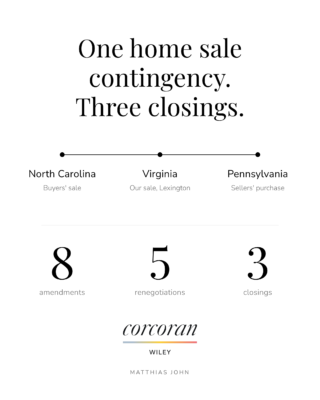 tingency in writing and kept the deal. The cash buyer could not move up. One house cannot carry two live contracts.
Most people think the story ends there. It does not.
What removing the contingency does not remove
Removing a home sale contingency means the buyers will close whether or not their house sells. It does not mean the deal is safe. The financing contingency can still be alive. Under our standard Virginia forms, a loan commitment does not end it. If the lender later pulls the loan, the buyers may still be able to terminate.
For my sellers, that was not abstract. Their sellers in Pennsylvania needed to believe Virginia would close. And my sellers had already given a lot. So the buyers’ loan could go through cleanly, they closed the business they ran on the property. The appraiser would see a house, not a going concern. That was real income, given up months before closing.
So we drafted one clean amendment: contingency removed, appraisal done, financing removed and waived, closing date confirmed. My sellers signed it.
Saturday
On a Saturday morning, the buyers answered through their agent. They said they were committed to closing, and the existing paperwork protected both sides. Another amendment was not necessary. It was polite. It was also a no.
By the afternoon, they offered to confirm their financing as “satisfied.” Not waived. Satisfied. The difference is one word, and that word decides whether a buyer can still walk.
My co-listing broker asked the question that mattered. The sellers have already signed the clean amendment. Why will the buyers not sign it?
In the end, they signed.
Three closings
On October 30, the house closed. The buyers’ sale in North Carolina closed. My sellers’ purchase in Pennsylvania closed. Three families, three states, one chain. It held. Not on the first date, and not without renegotiation, but it held.
If you are looking at an offer with a home sale contingency
Netting it out:
- Price the risk. An extension can carry a fee, and a fee outside the price does not touch the appraisal.
- Keep a kick-out, and keep it short.
- Make part of the deposit hard once the timeline gets long.
- When the contingency comes off, ask what is still alive: financing, appraisal, inspection, deposit.
- If your next purchase depends on this one, you need one clean document, not a stack of emails.
A home sale contingency can work. This one did. It worked because every concession was traded for something, and because nobody confused “removed” with “safe.”
If you own a property like this, or you are weighing an offer that depends on another sale, I am glad to talk it through.
Some details have been altered to protect client confidentiality.

Matthias John is a licensed REALTOR® serving Central Virginia since 2014. With dual Master’s degrees in Public Policy & Governance and Political Science & Linguistics, he brings analytical expertise to every real estate transaction.
Originally from Germany and multilingual, Matthias combines international perspective with deep local knowledge of the Charlottesville market. His background in public policy and sales enables him to navigate complex negotiations and regulatory requirements with precision.
Matthias specializes in helping both first-time homebuyers and property investors find opportunities that match their specific needs. His data-driven approach and commitment to transparent communication have earned him recognition among clients for his integrity and thoroughness.
As a longtime resident of Central Virginia, Matthias leverages his community connections and market insights to create customized marketing strategies for sellers and targeted property searches for buyers.
Member: National Association of REALTORS®, Virginia Association of REALTORS®