

There was no crisis behind this sale.
No unexpected appraisal problem. No major disagreement over value. No need to convince the sellers that it was time to move.
They already knew.
My clients had lived in the same house for about forty years. The husband had built it himself on land that had come from his parents. They had raised a life there, and now they had decided what came next: traveling the country in an RV.
They were ready to go.
My job was to make the sale feel as straightforward as their decision. With a home that has been held for decades, that does not happen by accident.
There are aging systems to account for, old records to untangle, inspections to anticipate, family members to coordinate with, and dozens of decisions that can become stressful if they arrive at the wrong moment.
The most important work I did on this sale had very little to do with marketing.
It was making sure the sellers did not have to handle all of those small tasks themselves.
Forty Years Changes the Way You Prepare a Home for Sale
The house was solid, but forty years leaves a history.
The septic system dated to the mid-1980s. The windows were original. Some of the plumbing was older. None of this came as a surprise, and that was important.
Before the home went on the market, we had already thought through which parts of its age should be treated as projects and which were better treated as known pricing considerations.
Not every older component needs to be replaced before a sale.
For a long-tenured homeowner, the more useful question is often whether completing a project will materially improve the sale or whether buyers are better served by seeing the property’s condition clearly reflected in the price.
We made those decisions before there was an offer on the table.
So when inspection requests eventually came, we were not trying to determine our position in the middle of a negotiation. We could explain that the price already accounted for the age of certain systems, address the remaining concerns fairly, and agree on an appropriate credit.
When the septic repair was underway, the buyers and sellers, their agents, and family members all stood together around the open system while the company worked on the tank ten feet in the ground, the distribution box, and the drain field. Everyone could see exactly what was being repaired and how the work was being handled. Nothing was concealed, and nothing had to be traded back and forth through lawyers.
The negotiation stayed short because much of the thinking had already happened.
That is one of the biggest lessons I take from selling homes that have been owned for decades: a calm transaction is usually a prepared transaction.
Long Ownership Can Leave a Paper Trail Too
The physical house was only part of what needed preparation.
The property had entered the family through a deed of gift a generation earlier. After decades of ownership, there were title matters in the public record that needed to be cleared before closing.
Nothing about that was unusual enough to derail the sale. But it did require time.
And time becomes much more expensive once there is a buyer, a lender, a settlement date, and several people waiting for an issue to be resolved.
If you have owned a home or family property for a long time, particularly one that was transferred through an inheritance, gift, or older family arrangement, I recommend looking at the title work early.
Old records have a habit of becoming urgent only when someone finally needs them.
Finding those issues before a buyer is waiting allows them to remain paperwork rather than become a problem.
Sometimes an Adult Child Becomes the Coordinator
Another part of this sale will sound familiar to a lot of families.
Much of my day-to-day communication ran through the sellers’ son.
That can be an extremely effective arrangement when everyone understands the roles.
The sellers still made every meaningful decision about their home. The son helped coordinate the logistics, keep communication moving, and make the process easier for his parents.
That distinction matters.
An adult child can help carry the administrative weight of a parent’s home sale without taking ownership of decisions that still belong to the parents.
In this case, it created a simple structure: decisions stayed with the sellers, while much of the coordination flowed through their son.
Everyone knew who needed to know what, and the sellers did not have to manage every moving part themselves.
A Personal Sale Still Needs a Disciplined Offer Review
When the offers came in, there was more than one to consider.
Even on a sale with this much personal history attached to it, the offer review was the same professional exercise I would use anywhere else.
We looked beyond the top-line price and considered financing strength, terms, contingencies, and the likelihood that each offer could actually reach closing.
The highest number on the first page is not automatically the strongest offer.
The goal was still to choose the contract that best protected the sellers through the rest of the transaction.
Trust Is Also Built by What You Volunteer
There was a small moment during the inspection negotiation that I remember because it illustrates another part of representing someone well.
I was aware of a point that the other side had not specifically asked about, but that could potentially affect how something was perceived. I disclosed it proactively rather than waiting to see whether anyone raised the question.
It was not a dramatic moment, and it did not need to be.
Trust in a negotiation is often built through the information you are willing to volunteer, not only through the questions you are required to answer.
That kind of transparency helped keep this transaction what it had been from the beginning: straightforward.
The Sellers Were Ready. That Mattered.
Preparation can solve a lot of logistical problems, but there is one thing no real estate strategy can manufacture.
Readiness.
These sellers had already decided what they wanted the next part of their lives to look like. They were not being pushed toward a move they were unsure about. They were ready, and that allowed us to focus on making the path from one chapter to the next as uncomplicated as possible.
Not every homeowner who has spent decades in a property is at that point.
Sometimes the right outcome of an initial conversation is to sell. Sometimes it is to prepare for a future sale. And sometimes it is to stay exactly where you are.
I wrote more about that distinction in When Not to Sell Your Home in Charlottesville, VA. For this couple, though, the decision had already been made.
They wanted to see the country. We just needed to get them there.
Forty Years Does Not Fit in a Moving Truck
After settlement, I wanted to give the sellers something that reflected what they were actually leaving behind.
A gift card did not feel right. Neither did a bottle of something they would eventually use and forget.
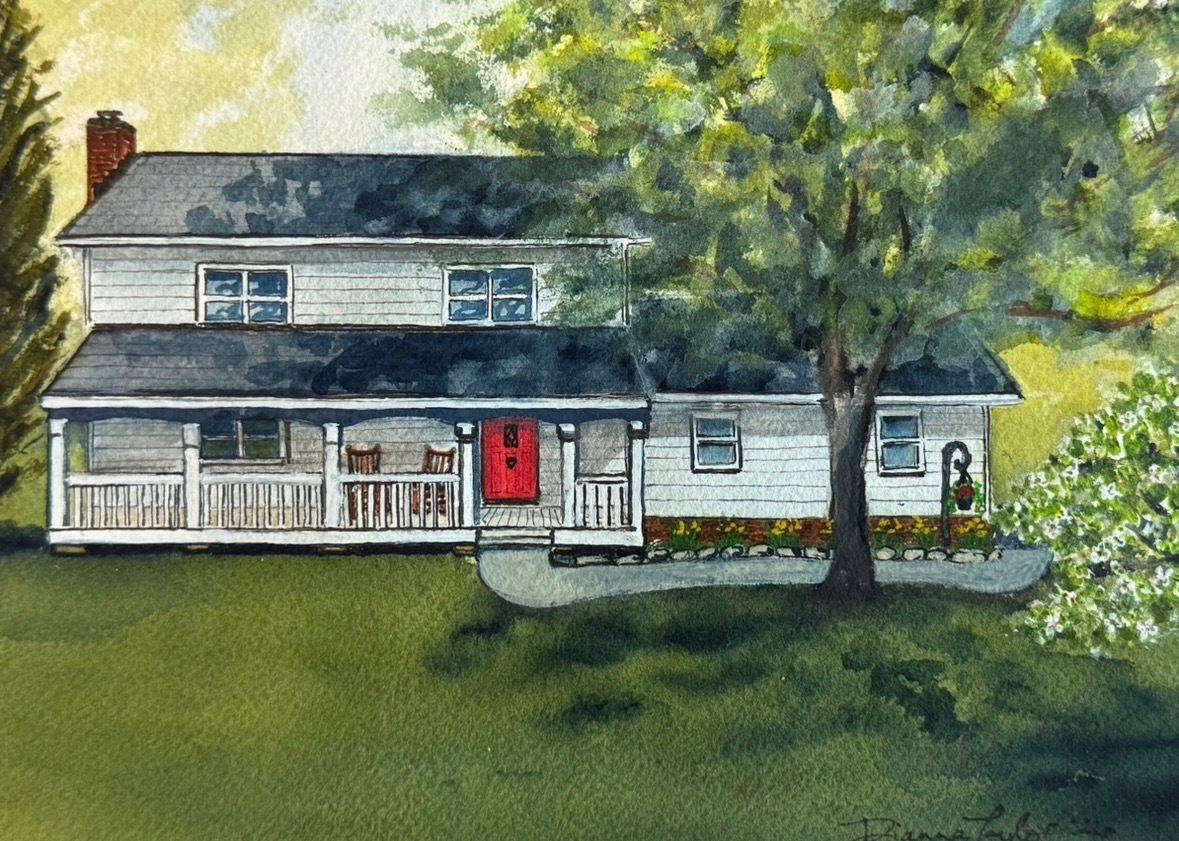
So I commissioned a painting of the house.
It was a way for them to take a version of it with them on the road, without needing to take the house itself.
The husband wrote to me afterward about the painting and about closing that chapter of their lives.
But the word he used to describe the sale itself was simple:
Easy.
I want to be careful with that word. The process was easy. The goodbye was not. You do not hand over a house you built with your own hands, after forty years, and feel nothing. Both things were true at once. A well-run sale cannot take away the weight of leaving. What it can do is make sure that is the only weight they carry.
Selling a home after forty years probably should not feel emotionally meaningless. But the transaction itself does not need to make an already significant life change harder.
A calm sale is not always a lucky one. Often, it is the result of a hundred small things being anticipated, organized, and handled before the sellers ever have to worry about them.
Forty years does not fit in a moving truck.
Sometimes it fits in a frame.
Thinking About Selling a Long-Held Home in Central Virginia?
If you have been in your home for decades and are starting to think about what comes next, I do not think the first conversation needs to begin with a list price.
It can begin with whether you are ready, what the property may need before a sale, what paperwork should be reviewed early, and what would make the process easiest for you and your family.
For homeowners in Charlottesville, Albemarle County, Augusta County, Nelson County, Rockbridge County, Orange County, and throughout Central Virginia and the Shenandoah Valley, you can explore my seller resources and home valuation options when you are ready to start that conversation.
Some identifying details have been omitted to protect client privacy.

Matthias John is a licensed REALTOR® serving Central Virginia since 2014. With dual Master’s degrees in Public Policy & Governance and Political Science & Linguistics, he brings analytical expertise to every real estate transaction.
Originally from Germany and multilingual, Matthias combines international perspective with deep local knowledge of the Charlottesville market. His background in public policy and sales enables him to navigate complex negotiations and regulatory requirements with precision.
Matthias specializes in helping both first-time homebuyers and property investors find opportunities that match their specific needs. His data-driven approach and commitment to transparent communication have earned him recognition among clients for his integrity and thoroughness.
As a longtime resident of Central Virginia, Matthias leverages his community connections and market insights to create customized marketing strategies for sellers and targeted property searches for buyers.
Member: National Association of REALTORS®, Virginia Association of REALTORS®